Jackie Bassett · The Up Series, 7 to 70
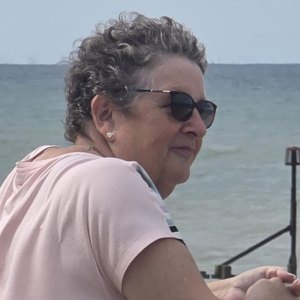
Jackie's through-line is defiance under narrowing circumstances. Chosen at seven for being unable to stop talking, she married at 19, was written off by the film as a working-class girl who had settled too early, and spent the next four decades proving the questions wrong rather than the answers: divorced at 35 and bartending with a toddler, a single mother of three in a Lanarkshire council flat by 42, permanently disabled by rheumatoid arthritis and on benefits from her late thirties, then buffeted by a run of deaths — Ian, her sister, her father, her friend Lynn. What makes her the series' conscience is that she alone kept turning the camera round: at 21 she bristled, at 49 she told Apted he would never have asked the men those questions, and at 63 he finally agreed. In the 2026 finale she has left Scotland for a retirement complex on the Norfolk coast with a new partner, Eddie, an East End acquaintance from childhood, calling it her "second childhood" and signing off in tears: "and with that, I'm saying, done, I'm finished, over."
Age 7 · 1964 · Seven Up!
Jackie is the chatterbox of the three East End girls, treated by the filmmakers as a unit rather than as individuals. The film frames them as the working-class children whose future is assumed to be early marriage and motherhood.
- Selected from an East End primary school with classmates Lynn and Sue; the three are filmed and questioned together.
- Talkative, confident child — the reason (she says) the teachers put her forward.
- At the London Zoo outing she claims one of the boys "loves Lynn".
Age 14 · 1970 · 7 Plus Seven
A cheerful teenager at a comprehensive, already uneasy with being asked mainly about marriage and babies. The seeds of her later quarrel with Apted are visible here.
- Attends a comprehensive school (as does Sue; Lynn went to grammar school).
- Speaks positively about her school — girls do metal- and woodwork, boys do cookery.
- Apted warns the three girls there is "a danger" they will marry, have children and be stuck at home; the boys are never given this either/or.
- Reportedly dismisses the whole project as pointless and silly — a view she repeats at 21.
Age 21 · 1977 · 21 Up
A young wife with a bank job and a new-build home in Essex, defending an early marriage against an interviewer who plainly thinks it a mistake. The exchange about "enough men" is the moment she will still be angry about at 49 and 63.
I've had the opportunities in life that I've wanted.
You do think, 'Christ, what have I done?'
- Married at 19; has been married "a year and a couple of months" when filmed.
- Clerical work for an Australian bank in London.
- Lives with her husband on a new housing estate in Essex.
- Apted asks whether she had met enough men before marrying and whether marrying so young worries her; she is visibly uncomfortable, looks at the floor, and pushes back.
- Insists the three of them have had the opportunities they wanted; Lynn is described by the others as the career-minded one.
Age 28 · 1984 · 28 Up
Stable and married, childless by choice, and still filmed as one-third of a group. 28 Up gives Jackie little individual screen time — her life looks settled.
- Still married; has chosen not to have children so far.
- The three East End women are once again interviewed together, in a living room, rather than separately — a decision the series was later criticised for.
- Working; no dramatic change since 21.
Age 35 · 1991 · 35 Up
The settled life of 28 has gone: Jackie is a divorced single mother of a toddler, bartending for low wages and leaning on her family. She is candid that class narrowed her options more than she once admitted.
We only had a limited choice, to be fair.
- Divorced since 28 Up.
- Has a son, Charlie, about 18 months old, from a brief relationship; raising him alone.
- Working low-paid bar work after having given up her earlier career on marriage.
- Money is tight but she says it always "turns up"; her father and siblings are very supportive.
- Admits, with Sue, that the choices they claimed at 21 were in fact limited.
Age 42 · 1998 · 42 Up
A single mother of three boys on a Lanarkshire estate, far from the East End. She is self-critical about wasted potential and says her own father might have pushed her harder — a mistake she means not to repeat with her sons.
I have no doubts I could have done more. Maybe I was lazy.
- Now mother of three sons — Charlie, plus James and Lee from her relationship with Ian.
- Moved from London to Scotland (Newmains, near Motherwell/Glasgow) around 1995, when Charlie was five and about to start school; Scotland becomes her home for three decades.
- Relationship life described as turbulent; her sons, filmed at dinner, are her anchor.
- Health problems beginning (the rheumatoid arthritis that will put her on disability benefit from roughly this point).
Age 49 · 2005 · 49 Up
Poor, in pain and on benefits in Scotland, Jackie nonetheless owns 49 Up: she turns the interview on the interviewer, naming the gender and class bias of 28 years of questions. It is the series' sharpest fourth-wall moment.
You wouldn't have asked some of the other people in this programme that question.
How dare you say that to me! Is that a worry? Why would that be a worry?
I think I'm actually more intelligent than you thought I would be.
You will edit this programme as you see fit, I've got no control.
- Lives in a council flat near Glasgow on benefits; rheumatoid arthritis has stopped her working.
- Raising three sons alone; nostalgic for the close community of her East End childhood.
- Openly confronts Apted on camera about the marriage/sex questions he asked the women but not the men, and about the narrative his editing has locked her into; Apted keeps the confrontation in the film.
Age 56 · 2012 · 56 Up
56 Up finds Jackie grieving and fighting the benefits system at the same time, yet buoyed by her first grandchild and her sons. Her defiance of the "fit to work" ruling became one of the film's most quoted passages about austerity Britain.
If David Cameron can find me a job then I'll go to work.
I can't use my hands, I can't sit for long, I can't stand for long, I can't walk very far.
My glass is always half full, never half empty.
I've reached a level in my life that I'm happy with; I enjoy being me.
- Has been on disability benefit for 14 years because of rheumatoid arthritis; under the coalition government's reassessment she is declared "fit to work" despite being unable to use her hands or stand for long.
- A run of bereavements: her sister, her ex-partner Ian (father of James and Lee), her mother-in-law, stepmother and brother-in-law.
- Ian, who was undergoing cancer treatment, died after being hit by a car in November (recounted in the film as 18 November; the family's first grandchild, a girl, was born three days later and he never met her).
- Son Lee is joining the army as a medic; son James is expecting a baby.
- Has tried internet dating; describes herself as an optimist.
Age 63 · 2019 · 63 Up
Frailer and bereaved, Jackie is still the participant most willing to argue with the film about itself, and 63 Up finally lets Apted answer her. Her hopes have shifted to the next generation — a granddaughter she is determined will go to university.
I felt that you treated us, as women, totally different, and I didn't like it.
By the time we hit 21, I thought you'd have a better idea of how the world works — you still asked us the most mundane domestic questions.
You're going to uni. You're going.
- Still living near Motherwell; rheumatoid arthritis markedly worse; fears her disability benefits are again under threat.
- Grandmother of five; tells her granddaughter firmly that she is going to university.
- Talks about the deaths of Ian and of her father, and of her childhood friend Lynn (died 2013).
- Tells Apted directly that he treated the women differently from the men and that even at 21 he asked them only "mundane domestic questions"; Apted concedes the point in the film.
- Despite everything, describes herself as lucky.
Age 70 · 2026 · 70 Up
The finale finds Jackie, against all the series' expectations, at peace: out of Scotland and on a Norfolk beach with a new partner and a gym membership, saying life has got 'a lot easier'. She gets the last word on the questions she has fought for half a century, and ends it herself.
I think I'm living my second childhood actually.
I needed peace for myself. The sunshine helps and makes me feel better.
He just had this idea that, even at 21, we were just going to be little women in the kitchen.
And with that, I'm saying: done, I'm finished, over!
- 70 Up (dir. Asif Kapadia, ITV1, 15 and 22 September 2026): Jackie has left Scotland after some 30 years and moved to the Norfolk coast, with a place of her own in a retirement complex.
- Living with a new partner, Eddie, an acquaintance from her East End childhood who had followed her on television and reconnected with her; they go to football and have travelled to America together.
- Has taken up the gym; says the sea air and sunshine have eased her health and that life is "a lot easier" since the move.
- Reflects again on Apted asking the women, not the men, about marriage and sex, and on her late ex-partner Ian, whom she says she never stopped loving.
- Remembers Lynn as "a very special person"; closes her final interview in tears, thanking the series.
Turning points
- Age 21: Marriage at 19 and the on-camera clash over whether she had "met enough men" — the grievance that defines her relationship with the series.
- Age 35: Divorce and a son from a brief relationship; from here she is a single mother on low pay.
- Age 42: Move to Scotland (c. 1995) with three sons; onset of rheumatoid arthritis that soon ends her working life (on disability benefit for 14 years by 2012).
- Age 49: Confronts Apted about gender and class bias; the series keeps it in and she becomes its most vocal critic from within.
- Age 56: Ian's death days before their first grandchild is born; declared 'fit to work' under benefit reassessment — grief and austerity in one film.
- Age 70: Leaves Scotland for the Norfolk coast with new partner Eddie, seeking 'peace' for herself; declares herself finished with the series.
Looking back
What people say
At forty-nine she told Apted to his face that he would never ask the men the questions he asked her; at sixty-three he agreed. It is the strongest criticism from inside the series, and the reason she is called its conscience.
Married at nineteen, she was presented as the working-class girl who settled too early; over the next forty years, through divorce, single motherhood, rheumatoid arthritis, benefits and one bereavement after another, she showed that what was wrong was not her answers but the questions.
At seventy, by the sea in Norfolk: "I think I'm living my second childhood, actually." Then she said she was done.
What this life shows
The questions decide what life gets filmed.
Ask only whether she will marry and how many children, and she becomes the girl who married early; ask differently and she is a woman who raised three sons alone and lived with pain for thirty years. Women being asked when they plan to have children while men are not is the same question in its present form.
Health is where class collects last.
Rheumatoid arthritis ended her working life in her late thirties, and at fifty-six she was still being reassessed as fit for work. The lower the class, the earlier the body gives out; that holds in every country. In a welfare state it looks like this: there is support, but you must keep proving you are ill.
When losses come one after another, what holds a person up.
Ian, her sister, her father and Lynn died in turn; at seventy she is by the sea with Eddie, someone she knew as a child in the East End. A new attachment late in life is real, not a consolation.